Neurodiversity Celebration Week

March 21, 2025


During this year's Celebrating Neurodiversity Week, a variety of engaging events took place at Norwich School to promote awareness and inclusion. The refectory was brightened by the installation of colourful umbrellas as part of the ADHD Foundation's Umbrella Project, symbolizing the variety and diversity of minds within our community. Each Umbrella Project display is designed to represent the one in five of us who have a neurodevelopment condition, such as ADHD, Autism, Dyslexia, Dyspraxia or Tourette's Syndrome. These fall under the umbrella term of neurodiversity. The project aims to change the perception of neurodivergent people and celebrate all the many strengths that come from thinking differently.


The school's Neurodiversity Group organized a creative badge and bracelet-making drop-in session at the Undercroft Library, fostering creativity and connection. We also launched the termly SEND Cafe, which aims to provide a supportive space for parents of neurodivergent pupils.


ON Betsy James delivered an inspiring assembly, sharing her journey of learning to celebrate her neurodivergence and the positive impacts it has on her life;


For clarity, I’m autistic and have ADHD. Trying to sum up what that means is tough — because I don’t know what it’s like not to be neurodiverse. It’s like asking, “Why do you like being you?” I don’t know … I guess I’ve got good teeth… 

Focusing on the positives of neurodiversity can be challenging. It’s much easier to think of all the struggles because, honestly, if everything had been fine, I wouldn’t have ended up at the doctor’s office, begging for answers. 

Under normal circumstances, I’d make self-deprecating jokes about my ADHD, how it makes me talk too much, or how my overstimulated brain makes me forget my noise- cancelling headphones — which inevitably causes panic and chaos. Listing negatives is easy. Being kind to myself? That’s much harder. 


So, I asked my parents to help brainstorm the positives, and as my biggest supporters, they were quick to remind me of the things I’ve come to take for granted. 

  • I’m a great communicator - because I’ve had to be. When your brain doesn’t work like everyone else’s, you explain yourself a lot. I write well, speak well, and listen well — because if I don’t, neither me nor the people I’m talking to know what’s going on. When I was getting my diagnosis, I was able to describe to the doctors exactly what I felt. People used to call me “emotionally intelligent,” but really, I’m articulate out of necessity. 
  • I’m academically organised — because I have to be. My brain is constantly racing, so I rely on planners and to-do lists otherwise I’ll forget even the simplest of tasks. Plus, there’s something deeply satisfying about ticking tasks off a list. If you don’t do that already, try it please. It’s an absolute game-changer. 
  • I’m deeply observant and learn quickly. I might miss some social cues naturally, but books and plays have also taught me a lot. Authors and playwrights alike have created brilliant characters, and I’ve learned a lot from fictional people. It’s a weird way to develop social skills, but it works, most of the time. I still need a hint or a nudge here and there but that’s what my friends and family are for. 
  • I’m incredibly loyal and deeply empathetic. I feel people’s emotions in a way that used to be exhausting, but now, I see it as a strength. My way of showing I care might be unconventional — like the time a friend had a panic attack, and I calmed them down by describing the entire plot of a 600-page book — but it works. 
  • I owe my entire degree to my neurodiversity. I study English Literature and Drama — two worlds that have always made sense to me. Books gave me a place to hide when I needed it, and the stage became my safe space. When I perform, a learned script means no surprises. Even on bad days, I can step on stage and feel totally in control. 
  • My acting skills are stronger because I’ve spent my life mimicking people. Observing mannerisms, mirroring speech patterns — it’s second nature to me. Recently, someone told me I embodied a blind 70-year-old man perfectly. Which is … odd, considering I’m neither blind, nor a man, nor 70 years old. But hey, I’ll take the compliment. 

I wonder how many of you, neurodiverse or not, see parts of yourselves in this? It can be difficult to celebrate neurodiversity sometimes, but I love my autistic quirks. I don’t know life any other way, and now I own it. 


When life feels like a struggle, don’t be afraid to ask for help. Norwich School has neurodiversity experts, allies, and champions who want to help you figure out how to be your best self. I’m eternally grateful to the teachers and staff who never doubted me and took the time to understand how I worked. 


And to those neurodiverse people listening — keep being your quirky, geeky, chatty, stubborn, quiet, loud, introverted, extroverted, fantastic selves (all words that have been used to describe me at one point or another). EVERYONE benefits when we’re all allowed to be who we are. So own it. 


Thank you for listening. 


The Close Creatives Collective produced a thought-provoking video featuring interviews on perceptions and experiences of neurodiversity, which was used to spark meaningful discussions in tutor groups.

You can watch it below!


By Eleanor Lewis March 17, 2026
The Choristers visited London on Wednesday 4 March to sing Evensong with the Temple Church Choir. We left from Norwich train station at 9.30am after a quick rehearsal, and arrived in London in time for lunch at Zizzi. We were then shown around St Paul’s Cathedral and enjoyed testing out the acoustics in the Whispering Gallery. After braving the narrow spiral staircases all the way up to the Golden Gallery, we admired the spectacular views over London. At the end of the tour we had a group photo on an amazing cantilever staircase (used in the Harry Potter films as the way to the Divination classroom), and then walked to the Temple Church. Following a rehearsal with their choir, they all sang Evensong together at 6pm. The standard of singing was breathtaking, a testament to the hard work and dedication these young musicians display on a daily basis. We caught the 8pm train and arrived back in Norwich just before 10pm, tired but happy after a rewarding and fulfilling day. Pupil Highlights: “The whole day was 10/10. I especially enjoyed seeing the spiral staircase in St Paul’s used in the Harry Potter films!” “My favourite part was singing at the Temple Church with the other choir. I also liked the view from the top of St Paul’s Cathedral, even if it was very high up - I’m not great with heights!”
By Sonja Mitchell March 16, 2026
With thanks to an award from the Friends of Norwich School, the Community Knit Club has been busy knitting winter essentials.
By Eleanor Lewis March 16, 2026
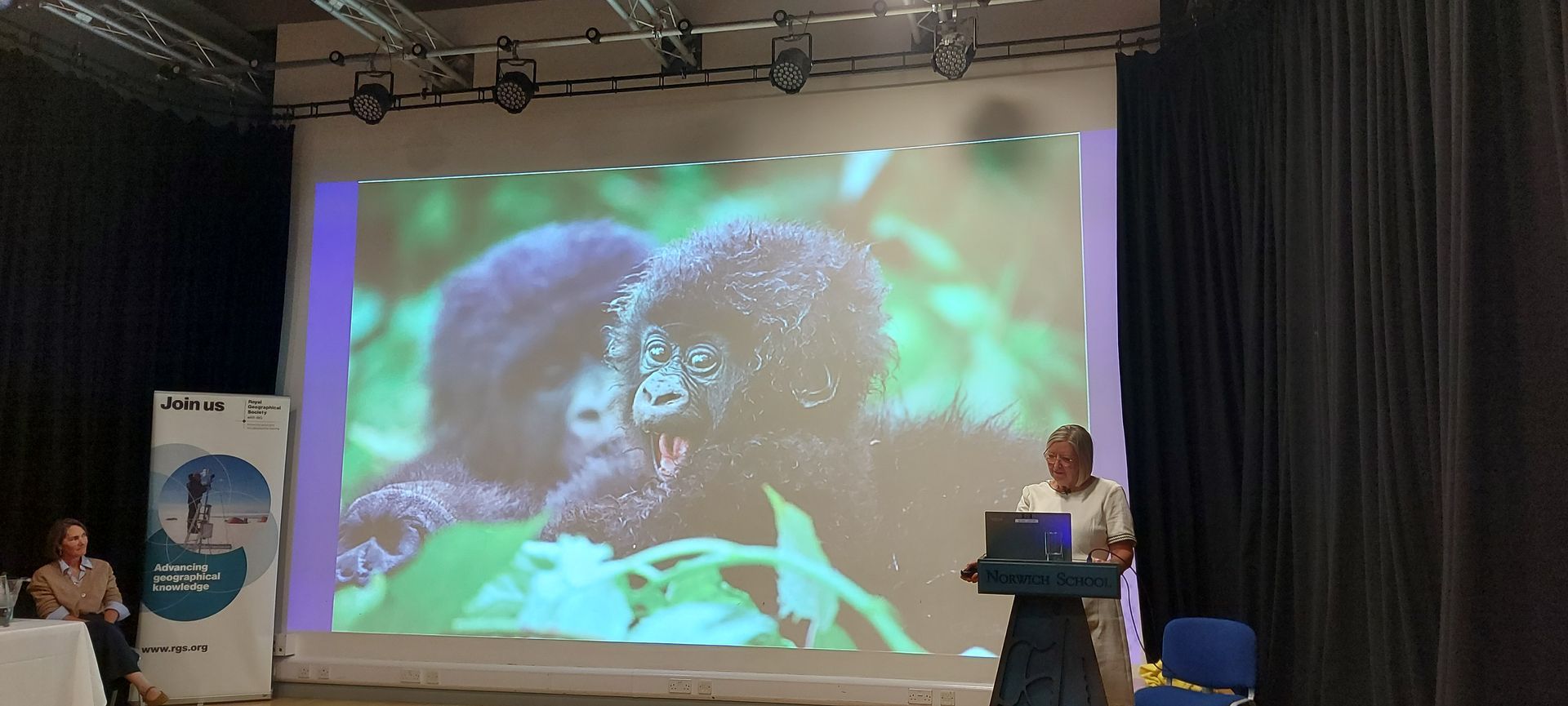
Norwich School has had the honour of being the host site for the Royal Geographical Society (RGS) in the East of England since 2019. Ours is an ideal venue for their engaging public talks from renowned experts about the physical, human and environmental world around us. On 16 March 2026 we heard a terrific presentation given by Stephen Akester entitled Rethinking the future of our seas, and what you can do to help. Stephen is a veritable font of all knowledge concerning global fisheries and fish stocks. He is a highly respected expert who advises the World Bank, the UN Food and Agriculture Organisation, and national governments on fisheries policy. Through comprehensible interpretation of data and up-to-the-minute fishing vessel GPS tracking information, he gave us a compelling and intelligent assessment of world fish stocks and practices. Whilst there are clearly some areas of deep concern, unsustainable practices involving indiscriminate bottom trawling and unregulated industries in offending countries, Stephen also gave an upbeat assessment of areas where sustainable fishing has seen some dramatic recoveries in levels of nutritional, tasty fish that we can land on our dinner plates with a clear conscience. A large audience of pupils, staff, alumni, Fellows of RGS, academics and parents left the talk better informed and hugely impressed by our speaker. His professionalism, steely determination to drive best practice and genuine environmental concern was evident to all, especially when fielding a stimulating Q&A afterwards and over refreshments. Attracted by such ‘fishy’ goings-on, even Budge, the Cathedral Cat, put in a guest appearance, and sat salivating over big tuna on the screen! These RGS talks offer intellectual rigour and great entertainment for professionals/academics and the lay person alike, and are always well worth attending, whatever the topic under discussion. The next talk will be given by accomplished and award-winning wildlife cameraman and director Toby Hough, who is also a proud Old Norvicensian. His credits include work seen on Countryfile, The One Show, Springwatch and numerous BBC wildlife documentaries and travel programmes. His talk promises to be a memorable visual feast! Tickets are on sale here: RGS: Toby Hough - Lemurs to leopards: filming adventures from around the world . All are welcome. It takes place on Thursday 7 May 2026 at 19:30 in the Blake Studio.
By Eleanor Lewis March 16, 2026
On 12 March, Upper 1 embarked on a fascinating journey back in time with a visit to Castle Rising, bringing their learning about medieval castles to life. During the trip, the children discovered that Castle Rising Castle is one of the finest surviving examples of a Norman motte and bailey castle in the UK. They learned about the huge earthwork defences that were carefully constructed around the castle, along with the imposing gatehouse and towering stone walls designed to protect it from attack. The children also discovered how a wide moat once completely surrounded the castle, forming a powerful and intimidating barrier that made it extremely difficult for enemies to approach. The drawbridge and portcullis were also vital features in controlling who could enter! Upper 1 learnt about the Murder Hole, a clever defensive feature used by castle guards to drop boiling water, stones, or other objects onto attackers below. The children also explored the remains of the castle kitchen and stepped into the magnificent Great Hall, imagining the feasts, meetings, and celebrations that would once have filled the room. They listened to stories about a bedchamber believed to be one of the most haunted rooms in the UK, explored the original church built 200 years before the castle, and looked at the ruins of the bailey buildings. The trip was a wonderful opportunity for the children to consolidate their learning of life in a medieval castle.
By Eleanor Lewis March 13, 2026
Upper Sixth Physics pupils recently participated in the British Physics Olympiad hosted by the University of Oxford. The challenge involved answering a series of highly demanding abstract physics problems from beyond the scope of the A Level curriculum. Around 9000 pupils initially took part in the new Olympiad Round 0, with pupils needing to achieve above a threshold score to proceed to Round 1. Over 1800 pupils from 475 schools qualified for Round 1. The following pupils from Norwich School made it through to Round 1 and achieved these excellent results: Emile Verschoor Silver Arthur Dannatt Silver Adit Raje Top Gold Adit Raje's outstanding performance meant that he also qualified for Round 2 of the Olympiad - an exceptional achievement given that only 69 pupils out of the original 9000 made it through. He proceeded to gain a Silver Award in this event, an incredible achievement and recognition that he is one of the top young physicists in the country at problem solving.
By Eleanor Lewis March 13, 2026
On Friday 13 March, the Little Roots Allotment was delighted to welcome parents, grandparents and pupils to the open afternoon. This event gave families the opportunity to look round the evolving gardening space and experience the allotment in its new location. It was wonderful to see many families exploring the allotment and admiring the work that has been done by pupils so far. Pupils had the chance to get their hands dirty and plant their very own spring planters, which they took home— just in time to make the perfect Mother’s Day gift! Surrounded by cheerful flowers and newly emerging vegetables, the afternoon was filled with excitement, creativity, and an appreciation for the beauty of our unique school grounds.
By Sonja Mitchell March 12, 2026
The ever-popular Young Chamber participants have launched their businesses and are learning what it takes to be successful.
By Sonja Mitchell March 11, 2026
The programme helps athletes transition into senior international hockey.
By Eleanor Lewis March 10, 2026
‘Norfolk Suite’ Colour Photographs 18 April - 1 May 17 April Private Viewing, 18:00 - 20:00 Gallery Open 10am - 5pm. Closed Sundays. The Crypt Gallery, Norwich School. An exhibition of an edit of 50 colour photographs from a period from 2002 to the present of journeys around Norfolk. ‘These are not necessarily landscapes but notes, observations and points of the countryside and towns which I travelled through and stopped at’ There is no entrance fee but the works are for sale in limited editions of 10, prices and sizes on application.
By Eleanor Lewis March 10, 2026
Following a request from the pupils leading the school's Medical Society, Mrs Warren has run two after school sessions teaching sixth form pupils keen to study medicine and veterinary medicine how to perform surgical suturing on pigs' trotters.  Following a teacher demonstration, pupils enjoyed talking through the procedure and asking for consent from their trotter, followed by using scalpels to excise an imaginary cyst on the pig's skin. They then closed the wound by suturing the skin with surgical needles and thread, the most challenging part being 'throwing' the knot several times for each stitch and ensuring it was tight enough. Some promising skills were shown by our surgeons of the future.
More Posts