British Sign Language Club offers CPD accredited skills through FONS

March 13, 2025

The BSL club has seen a number of engaged pupils learn more about Deaf culture, including how to sign.


The British Sign Language (BSL) Club has seen great success since its inception, with consistent weekly attendance. On average, 13 pupils attend each week, with a maximum of 20 pupils participating during peak weeks. The club is designed to introduce and engage students with essential BSL skills, fostering an inclusive environment and promoting greater awareness of Deaf culture.


Each lunchtime session is focused on practical and essential skills, including:

  • BSL vocabulary
  • Fingerspelling
  • Numbers
  • Conversational phrases

Students are introduced to BSL's unique grammar, sentence structure, and non-manual features, such as facial expressions, that are crucial for effective communication. Engaging, interactive activities include:

  • Fingerspelling practice
  • Vocabulary games
  • Role-playing conversations

Additionally, pupils watch and mimic videos of fluent signers, participate in storytelling, sign songs, and engage in paired activities for practice in real-life contexts (e.g., describing images or having conversations).

  
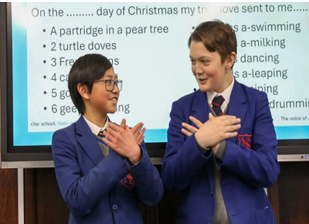
A notable achievement has been the filming of the “12 Days of Christmas” song, which was published in the school’s newsletter. This project provided a creative and fun opportunity for pupils to showcase their learning.
BSL - 12th Day of Christmas.mp4 


To further enhance the learning experience, 20 enrolments for an online BSL course provided by British-Sign.co.uk were purchased. This course offers a CPD-accredited certificate. 19 pupils have actively engaged with the course, completing online assessments in the Dyers ICT suite in early February.


We are extremely grateful to the Friends of Norwich School for their contribution of £200 towards these costs.


The next steps for the club will focus on expanding students' vocabulary and teaching the importance of positioning during sign language, especially in descriptive and listing contexts. Pupils will have another opportunity to use the Dyers ICT suite at the end of March to complete additional online units, with the goal of taking the final assessment during the summer term. Pupils will also have access to the online course for up to two years.


In June, there will be an exciting outreach opportunity with Caroline Speca and students from Clare School. This event will include a collaborative storytelling performance, with pupils from Norwich School signing a story alongside the school musicians and an art performance delivered by James Mayhew.


Thanks to the generous funding provided by FONS, the BSL club has made valuable progress in equipping pupils with essential language skills. This initiative has not only enhanced their ability to communicate in BSL but has also fostered a deeper understanding and appreciation for Deaf culture and the Deaf community. The club is empowering individuals with new skills and promoting inclusivity across the school.

By Eleanor Lewis February 3, 2026
On Tuesday 3 January, Upper 2 visited Norwich Synagogue as part of their learning about the local community. The children were immersed in an enriching experience that helped them develop an understanding of different cultures and traditions. They particularly enjoyed dressing up with a kippah and a tallit, and were fascinated by the opportunity to view the Torah scrolls. The visit provided a valuable and memorable insight into the Jewish faith and community around us.
By Sonja Mitchell February 3, 2026
Juliette Kelly (17-19), lead singer, is back on stage across the country with breakout indie band, Fright Years.
By Eleanor Lewis January 31, 2026
2026 is National Year of Reading and we are going all in here at Norwich School! We know reading expands worlds, sharpens minds, and fuels creativity, so let's get inspired! Every month we are focusing on a different genre and hearing from a member of staff about what they like to read, why, when and where! We are kicking off in January with Historical Fiction and one of the school's biggest fans of this genre has to be Mrs Morgan. Let's find out more about why Mrs Morgan loves historical fiction... Tell us a little bit about the genre; what common themes or elements do you particularly enjoy? I love the characters who reflect the beliefs, limitations and social pressures of their era. Stories that weave real historical events with imaginative elements showing how ordinary people experience extraordinary moments such as in ‘The Help’ by Kathryn Stockett. What was the book that introduced you to historical fiction? Was there a particular book or author that made you fall in love with this genre? I have always loved reading historical fiction even as a child and this is possibly why I went on to study History at university. When I was growing up I loved reading books based on historical events such as Little House on the Prairie , Goodnight Mr Tom , the Hornblower series, classics like The Secret Garden and books by Phillipa Gregory. Has your taste in this genre changed over time? I think in recent years I have focused more on the stories of people who lived through tumultuous times, but who had a story that hasn’t been told like Heather Morris’ The Tattooist of Auschwitz . Would you recommend this genre to someone who doesn’t usually read it? Why? I think historical fiction gives readers something unique: the opportunity to experience the past not as a list of dates but as a living world full of people who feel real. It helps us understand how individuals living at that time navigated the forces that shaped their lives – war, inequality, migration, discovering, and in doing so it deepens our understanding of how those same forces echo today. Do you tend to reread favourites from this genre or always look for something new? I never re-read books as I feel like there are so many books available, I don’t want to waste my time re-reading one, even if I loved it! When was the last time a book from this genre really surprised you? I really enjoyed There are Rivers in the Sky by Elif Shafak, as it follows the life of a drop of water as it travels through different time periods and locations, intertwining the stories of the three main characters across various time periods and countries. Do you prefer classic or modern books within this genre, and why? Both – I’m happy to read anything! Obviously one of the joys of my job is that I get to read many new children’s books so that I can recommend them to Lower School pupils such as Tom Palmer’s ‘Resist’ and ‘After the War’. What do you enjoy most about reading, whether historical fiction or anything else? The spotlight it shines on parts of history or everyday life that might otherwise go unnoticed. I have just finished reading a few books by Francis Quinn which focus on the lives of people who did not become famous, but who had a vital role to play within the societies in which they lived. The Smallest Man , That Bonesetter Woma n and The Lost Passenger all use real historical events as a backdrop for highlighting the ordinary people that have been caught in extraordinary circumstances. I have also recently enjoyed The Eights by Joanna Miller which documents the experience of the first women to study at Oxford University. When and where is your favourite time and place to read?/ Do you have a favourite reading spot or routine for diving into books? I usually only have time to read a few pages a night during term time, but I love to spend more time reading in the school holidays. In winter I love to sit on the sofa, in front of the wood burner with my dog snoring next to me and a cup of tea nearby! In the summer I enjoy reading outdoors, either in the garden or on the beach. Which fictional character would you most like to have a cup of tea with? I think I would like to share a cup of tea with Paddington bear as he would almost certainly bring marmalade sandwiches too! If you could step into the world of any book, which would it be and why? I would love to visit the Faraway Tree in The Enchanted Wood! I would be so excited to explore the magical lands and meet Moonface and Silky, although I would do my best to avoid Dame Wash-a-lot’s water! There is a film coming out later this year and I can’t wait to watch it. Click here to see Mrs Morgan's reading list!
By Eleanor Lewis January 30, 2026
Following Emi's success at the Norfolk Country Cross Country Championships we decided to ask her a few questions about her love of running and her upcoming London Mini Marathon. How long have you been running?/How long have you been running with the school? I have now been running for 3 years, and I have been competing for the school since Upper 3. How often do you run outside of school? I run with a training group 2-3 times a week depending on the dates of various competitions. How do you train?/How do you prepare for a race? I think that mental preparation is the most important; I use visualisation which can help me enter an open mindset. And I think it is mainly accepting that it will have painful aspects, but the aftermath feels phenomenal. And physically preparing, is a matter of being consistent at training in my case. How did you find the Cross Country championships? The Cross Country Championships was certainly nerve-racking beforehand, but I think the race went very smoothly and I left it all out on the course. And attempted to compete to the best of my abilities! Can you tell us a bit about the London Mini Marathon in April? Fortunately because of my performance at the County Championships I have been accepted to run at the London Mini Marathon! How are you feeling about it? As much as I am excited, there is no doubt I will be feeling nervous. But I think that it is a great opportunity, also to be surrounded by excellent runners! Where do you hope your running will take you? As for my running, I would like to compete at a high level but most of all I would love to continue to enjoy it! Because I truly believe if it is bringing you no satisfaction or joy, there is not a point in pursuing it. What piece of advice would you give to aspiring cross country runners? For people who are aspiring to do cross country as a sport, I would advise them to just have a go and give it a chance. Because if you are willing to give it a chance, you might just find that you will like it!
By Eleanor Lewis January 30, 2026
What a joyful and uplifting concert it was, packed with confidence, colour and lots of happy moments! From the very first notes, it was clear how much enthusiasm and hard work had gone into preparing this programme. The concert opened with the warm, rich sound of the cello in The Two Grenadiers by Robert Schumann, setting a confident and expressive tone. Some lively vocals and guitars performed Lush Life by Zara Larsson which was full of energy and great teamwork. The piano brought a touch of movie magic with Let It Go by K. Anderson, before switching gears completely with the dramatic rhythms of War Drums by F. Waterman. A beautifully calm moment came with River Flows in You by Yiruma on the piano, played with lovely control and feeling. The smiles continued with vocals performing 7 Years by Lukas Graham, showing great expression and connection with the audience. The bright sound of the trumpet shone through for Africa followed by a cheerful flute rendition of the traditional Pease Pudding . The piano took us on a fun musical journey with Yankee Doodle , then treated us to a confident and familiar Ode to Joy by Beethoven. Another gentle piano highlight came with Little by Little by F. Davies, played with care and musicality. A lively vocal performance of Golden from K-Pop Demon Hunters brought lots of sparkle and stage presence, while Tomorrow from Annie was delivered with real enthusiasm and a big smile. The pace picked up with an exciting drum performance of Skullcrasher , which certainly lived up to its name! The piano then returned with the flowing melody of Bluebird by P. Waterman, followed by a spirited violin performance of Wild West by D. Blackwell. The concert closed beautifully with The Singing Swan by P. Waterman on the piano, a lovely and confident finish to a fantastic event. Overall, this was a wonderful concert full of bravery, enjoyment and musical growth. Every performer should be incredibly proud—there were lots of smiles in the Lower School Hall and plenty to celebrate. Well done to everyone involved!
By Eleanor Lewis January 29, 2026
When pupils leave Norwich School, they reflect on the wonderful community in the Close, the teachers who supported them along the way, the friendships they made. However, in recent years as we look at the quotes of Upper 6 leavers, there seems to be a theme in what they'll miss - the food! To celebrate the work of our incredible catering staff we decided to ask Gareth Parry, Thomas Franks General Manager, a few questions... What does a day in your life look like? A typical day - Arriving in the morning and receiving a mountain of orders before the pupils are on site. Breakfast is freshly prepared and served from 7:45am to 8:45am. Chefs are busy prepping for the lunch ahead that day whilst front of house staff are getting the break time snacks ready and freshly preparing sandwiches etc. Lunch is served between 12pm and 1:55pm, then we clear everything down ready to start again the next day! There are various functions on throughout the week for which we might provide simply tea and coffee, buffet lunches or a three course sit down meal, it really varies from day to day. On average, how many meals are served at Norwich School in a day? On an average day we feed something in the region of 1250 meals for lunch. This can rise dramatically if we have functions on throughout the day and evening. What goes into planning a school menu? We proudly take time and effort to explore a variety of dishes from around the world, with a focus on nutrition. We have to consider catering for various age ranges from 4 to 18 and also consider a whole variety of dietary requirements. Finally we ultimately have to look at cost and keeping to a budget without compromising the culinary experience. What time does your day start and end? We have chefs on site from 6am, sometimes earlier! I am often the last to leave on a typical day without functions at 6pm. If we have a meal on in the evening, this can even run until midnight to clear up. What is the best part of your job? We certainly enjoy the creative side of cooking and providing hospitality to the masses and it is pleasing to educate people through food where we can. There is also the rush of lunch service which is fast and frantic, this keeps us on our toes and certainly makes time pass quickly! How does your work help pupils get the best out of their school day? We hope that the pupils look forward to coming into lunch for a tasty, well balanced, nutritional meal which helps fuel the body as well as the brain What is the most popular dish with pupils? Katsu Chicken Curry, it has been a staple on our menu for many years. Any fun facts for us? On a busy day we can clock up 40,000 steps each. Our average step count is 20,000 for the day. We use over 150kg of flour a week just to bake bread and make desserts for lunch time. Last year we cooked over 10,000 sausage rolls! In an academic year we serve over 4000kg of pasta at lunch times which is 4 metric tons! If your job had a theme song, what would it be? Food, glorious, food from Oliver!
By Eleanor Lewis January 29, 2026
Lower One pupils enjoyed an exciting educational visit to Africa Alive! as part of their topic on Safari. During the trip, the children took part in a hands-on workshop where they learned fascinating facts about African wildlife and their habitats. They also had the chance to see a range of incredible animals up close, including giraffes, lions and rhinos . One of the highlights of the day was a special animal encounter session, where pupils bravely touched giant African land snails and even met a snake . This experience helped the children develop confidence while learning more about animals in a fun and memorable way. The visit was a fantastic opportunity to support classroom learning and created lots of excitement and curiosity about the natural world.
By Eleanor Lewis January 29, 2026
At the St Nicholas Day service on Friday 5 December, Upper 4 pupil and Head Chorister, Sébastien Dubroeucq, was named Child Bishop. This ancient tradition is to highlight the importance of young people and their voices, allowing them to share their insight on the world we live in. To celebrate this, we asked Sébastien some questions... How long have you been at Norwich School? And how long have you been a chorister? I have been at Norwich school and the cathedral choir for four years now. Why did you want to be a chorister? I wanted to become a chorister as I enjoyed and still enjoy singing and performing and it gave me an opportunity to do these things on a regular basis! How do you find the week-by-week life of a Chorister? The choir life felt quite busy when I first joined, with 5 services a week, but it soon became like a routine and now is just associated with normal life! How do you fit it all in with your school life? Do you take on any extracurricular activities? I love performing in musicals and plays, and sometimes choir and play rehearsals overlap, but we always manage to arrange something mutually beneficial for the choir and my extracurricular activities. Can you tell us a little about what the child bishop is and what this involved? The child bishop is part of an old tradition on St. Nicholas day, where a child gives a sermon at the evensong and gives the dismissal and blessing. How was the experience of being the child bishop? The experience of being child bishop was really humbling, and it gave me a really good moment to reflect as I wrote the sermon. Had you heard of this tradition beforehand? I was present at St. Nicholas day for the child bishop last year so I had a pretty good grasp on the situation beforehand. What are your responsibilities as Head Chorister? My responsibility as head chorister is to make sure everyone in choir is feeling alright, and if they aren’t, helping them or pointing them to help. What would you say to anyone who is interested in becoming a Chorister? The experience of being a chorister is a truly remarkable experience and I would heavily recommend it to anyone who like singing or music!
By Eleanor Lewis January 29, 2026
These pupils gained the required grades and went onto start these courses in autumn 2025. Case Study – Georgia Hodgson: 1. Tell us about the university offers that you've received so far: Currently, I’ve received offers from Cambridge, Imperial, UCL and UEA for Medicine and Warwick for Biomedical Sciences! 2. On top of the usual UCAS application form, what else have you had to do as part of the admissions process to be considered for these highly competitive courses? For my medicine applications, I’ve had to take the University Clinical Aptitude Test (UCAT) entrance exam, which happened over the summer (between Lower 6 and Upper 6), and complete interviews at all four universities. These interviews involved learning about current NHS affairs, exploring skills from work experience/volunteer work and, for Cambridge, applying scientific knowledge from A Levels. 3. How did Norwich School help you during the university application process? Norwich School provided support during Lower 6 in the form of Apply Plus sessions, in which we were encouraged to think ahead about work experience, volunteering and super-curriculars; I found these sessions very insightful as I learnt a lot about the application process pre-emptively and was able to tackle my UCAS application a lot better as a result! During Upper 6, there was also support for interview preparation for medicine, dentistry and veterinary medicine applicants as we were able to take part in a mock interview, which helped me to identify my weaker areas and gave me an idea of how to prepare and what’s involved. 4. Which other activities in sixth form helped strengthen your application? Volunteering was a key experience that supported my application; I had undertaken some volunteering at Able2B, as well as partaking in community service through school. These experiences provided valuable learning opportunities that I was able to reflect on in my application and discuss at the interview. I also shadowed doctors in a hospital, which gave me a realistic view of what medicine entails that I could tie into my personal statement and interview answers, and excited and motivated me about the prospects of entering a career in medicine! On top of these, I completed and presented an 8000-word research project on the link between depression and cardiac health, entered several STEMM Olympiads and completed the Youth STEMM Award. 5. Outside of medicine-related activities, what have you been involved in at Norwich School during sixth form? During sixth form at Norwich School, I’ve led the Debating and Erpingham Societies, as well as taken up my new role in Upper 6 as Head of School and EDI. These have helped me develop other skills, especially those in communication and organisation, and have been a lot of fun! A particular highlight was being part of a team ranked 26th internationally at a debating competition! 6. Which offer do you think you will pick as your CF (conditional firm) and what most excites you about that course? I’m hoping to CF Cambridge’s medicine course! I find a lot of aspects of the course exciting; however, a particular aspect is the opportunity to intercalate in the 3rd year! I think this will help to broaden my knowledge and understanding of medicine and science as a whole, and the chance to research is an exciting prospect! I also look forward to participating in supervisions and discussing the subject with incredible scientists and researchers! Case study – Barnaby Karlson-Evans 1. Tell us about the university offers that you've received so far i.e. what course(s) at which unis. I have now received all of my offers, among those, Nottingham, York, Warwick and Durham for Law LLB (3 Years). 2. On top of the usual UCAS application form, what else have you had to do as part of the admissions process to be considered for these highly competitive courses? Ultimately, as an applicant, you want to prove why you are passionate about law. Certainly, when it comes to this field, work experience is desirable by universities. Although it’s not a requirement, it helps one’s application to stand out, which is beneficial as these courses become more competitive year on year. Universities understand that legal experience isn’t by any means easy to get, and if you find yourself in that position, don’t be disheartened; you can still attend talks, webinars, online courses or even sit in a courtroom as a member of the public. These alternatives don’t require you to contact someone in the legal field, are much easier to obtain and have just the same value. 3. How did Norwich School help you during the university application process? Mrs Warren and Mr Pearce were invaluable when it came to the application process. Explaining admissions assessments, checking over applications, proofreading and suggesting revisions to a personal statement are all examples of what the school helps with. They are both very knowledgeable and are always happy to help address any concerns. This all helps to take the pressure off during a workload-intensive time of study and thus, make the process a lot less stressful. 4. Which other activities in sixth form helped strengthen your application? The Independent Schools’ Mock Law Trial is one of the activities that strengthened my application. Getting hands-on experience, in a courtroom, acting as counsel (among other roles) is an invaluable skill which not only looks fantastic on your personal statement but also helps in other walks of life too, such as public speaking. Last year, the school progressed onto the national round, competing at the Old Bailey in London. This was a brilliant experience and if you’re interested in law, but not sure if it’s right for you, this can be a good taster of the subject and help you make up your mind. Debating Society was also an activity I used to do. It presents many opportunities to compete across the country, and also develops one’s critical thinking skills, which is beneficial when taking the LNAT, a law aptitude test, required by some universities. 5. Outside of law-related activities, what have you been involved in at Norwich School during sixth form? I particularly enjoyed being a part of Amnesty Society, where we organised charitable events and collaborated with other schools and organisations across Norfolk. Although academic study is a major part of Sixth Form, it is important to be involved in other clubs and societies too, and this can also help to add depth to your personal statement.
By Eleanor Lewis January 28, 2026
On Tuesday 27 January, pupils from the Charities Committee presented a cheque to the East Anglian Air Ambulance! This sum was raised by from an accumulation of events in the Michaelmas Term. Notably, our Home Clothes Day proved to be a popular method of raising donations. This combined with the efforts of a JustGiving page, hot chocolate sales and a retiring collection at the Carol Service meant that pupils raised a staggering £1379.84. Co-chair, Mimo O'Donnell (L6) commented, "Immy and I just want to say a big thank you for all the support from pupils!!"
More Posts